How do you help students improve at maths/science?
Updated: Sep 20, 2023
The process of improving at maths/science is a fundamentally long-term objective and can be broken down into two simple steps. It's important that a student understands both of these, and our tutors discuss this in detail with all students.

Step one: ensure comprehensive understanding.
Somewhat obviously, the student must understand the content. They must be able to conceptualise a topic, utilise a variety of techniques within the framework of the topic and use this understanding and technical ability to solve complex problems.
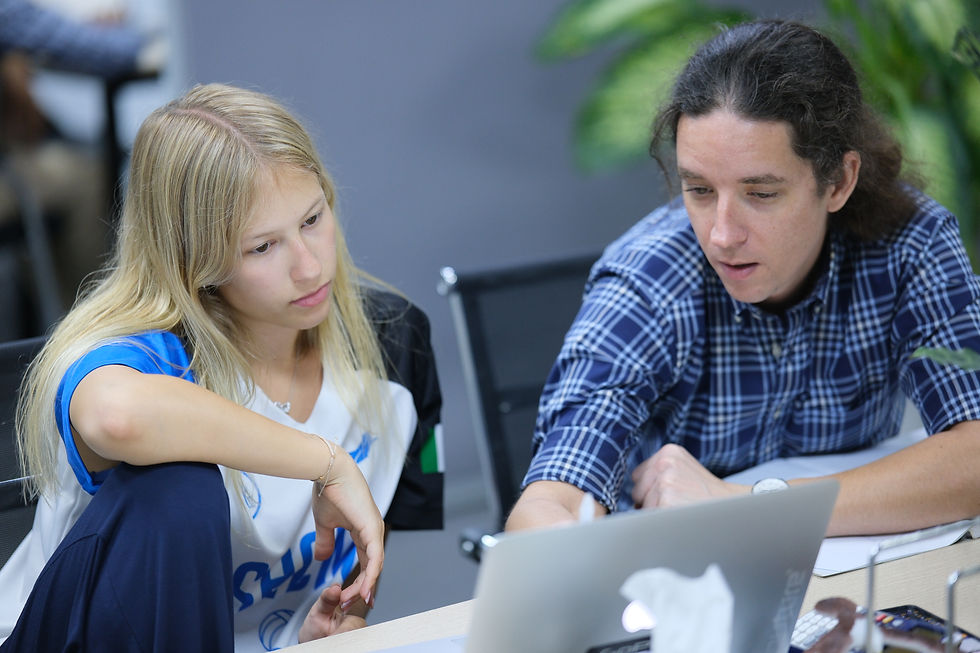
This is the area our sessions are, in general, focused on improving via discussion, demonstration and repetition. Our tutors are fluent English speakers (many of us are native), with at least an engineering or mathematics/science Bachelor's degree, are well-trained and highly familiar with the IGCSE/MYP/IB science and maths courses, and the Casio/Ti graphics calculators used by major international schools in HCMC. Our tutors are proficient at and will regularly use a variety of teaching tools, including graphics calculators (we use the Casio 9860GII / III and Ti Nspire), WolframAlpha, Excel/Sheets and macros, statistics software, various online simulations and others.
Step two: practice regularly.
As exams are heavily time-limited, having a solid understanding of a subject is not sufficient to do well. The student must be able to demonstrate their understanding quickly in a solo environment with zero assistance.
The student must therefore be very well-practised at solving problems, and they must practice regularly to develop high speed and accuracy in their work. In other words, they must be capable of demonstrating their understanding of the topic; clearly, accurately, and with minimum hesitation for the majority of exam problems, and the only way to do this is by practising. We generally suggest 15min per weekday (or about one hour per week) per subject as a baseline for most G9/Y10 and G10/Y11 students, more during the IB DP years. We provide a wide variety of resources to help our students achieve this and will continuously reinforce the importance of this practice where necessary.
It's important that this practice is done alone, with no tutor or friends to help. Exams are a solo experience, and practising working in this environment is another important aspect of preparation. Discussions with others about any topic or difficult problem after attempting is great, but regular practice should always be done alone.
It should not, however, be a stressful experience for the student. This practice should be focused on exercises that are now within the student's understanding. If difficulties arise with any particular problem, exercise or topic, the student should bring the problem to their tutor to help remedy their understanding and continue practising.
More generally:
1) Our tutoring sessions focus on helping students understand what it is they are doing and why. For example, if a student brings us a problem or concept they find too difficult, we explain what's going on, show them how to solve it, and make that problem easy for the student.
2) The student then, as soon as possible after a lesson, begins practising this topic and continues to revisit this topic periodically over the duration of the course. Since this topic should now be within the student's ability, this practice should be a relatively stress-free experience. It's simply maintaining understanding and developing technical speed by repetition.
These concepts shape our teaching processes which has been developed over years of experience tutoring maths and physics, and it has demonstrated a very high level of success with the vast majority of students.